

PC/104 Development
PC/104 DEVELOPMENT
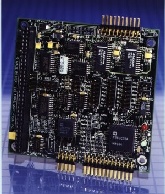
PC/104 CPU and peripheral boards are a great solution to resolve “intelligence” requirements integrated into industrial equipment, autonomous systems or independent measurement units. The evolution of PC-compatible boards in this format has grown enormously in the last decade, mainly because of the following advantages:
- Programming ease: Most applications use MS-DOS or some of the industrial variants. More powerful 32-bit versions can work directly with Windows or Linux.
- Wide software tool availability: Compilers, linkers and cross-assemblers are widely available at relatively low cost, since their use is standard in normal PCs. Good quality development tools for other processors are generally extremely costly software packages.
- RTOS capability: A complete Real-Time Operating System, or a simpler Real-Time Executive with multitasking capability can be integrated easily. This last alternative does not replace DOS, but adds multiple tasks and predictable execution time.
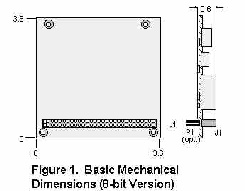
Figure 1: PC/104 Dimensions
The physical characteristics of the PC/104 (8-bit version) are standardized as shown in Figure 1. Dimensions: 3.8" × 3.6" × 0.6" (96.52 × 91.44 × 15.24 mm).
The main connector J1 is the equivalent of the ISA 8-bit bus connector originated in the days of the first IBM XTs (with reduced current physical drivers to reduce power consumption). Standardized versions also exist for 16-bit systems (extending the AT 16-bit ISA bus with an additional connector) and newer embedded PCI 32-bit formats. For additional information see www.pc104.org.
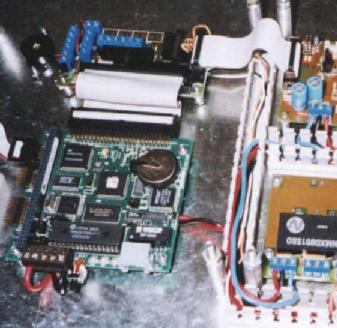
Figure 2: Micro/Sys CPU board project.
The special format of these boards allows them to be “stacked”, avoiding costly backplane boards and rack mounting systems. Alternatively, the boards can be connected on a flat surface (Figure 2).
Most PC/104 CPU boards integrate a number of hardware features not usual in normal PCs:
- A Watchdog Timer, which resets the CPU in case a software malfunction occurs.
- Special features such as Non-Volatile memory areas for calibration or setup parameters, and special RTC (Real Time Clock) hardware, sometimes with wake-up capability.
- Quality features (board design, heat dissipation) that make them usable for continuous operation. This sometimes includes extended temperature ranges of −40 to +85 °C.
Please mail us for further information, availability and pricing of PC/104 systems at L&R.